 Memecoin
 token unlocks follow different release schedules and claim windows
Memecoin token unlocks determine when eligible recipients can claim their allocated MEME tokens. The original Fire Sale and Memeland airdrop terms set different release rules and claim windows. Releasing an allocation removes its lock-up restrictions, while claiming transfers available tokens from the distribution contract. Full release does not mean every recipient has collected their allocation.
MEME is Memeland’s ERC-20 token. A holder may have entitlements from different distributions, each with its own conditions. The original 2023 terms explain the Fire Sale and airdrop schedules without setting a single timetable for every MEME allocation. Memeland later announced 4 July 2025 as the Fire Sale claim deadline.
Sale allocations and airdrop entitlements
Fire Sale entitlements came from confirmed sale allocations, while airdrop eligibility depended on qualifying Memeland assets and holder conditions. The Fire Sale Terms and Conditions, version 1.3, dated 7 November 2023, identify Glorious Meme Inc as seller. The Memeland Airdrop Terms and Conditions, version 1.2 of the same date, name Memeland Pte. Limited as campaign organiser.
An allowlist or waitlist participant needed an allocation from the Fire Sale; a waitlist place alone did not guarantee one. Airdrop entitlements depended on a qualifying NFT from You The Real MVP, The Potatoz or The Captainz, or on Wallet Maps. Holding MEME bought later in the market did not, by itself, establish either original entitlement.
Release and receipt as different states
An allocation records the MEME associated with an entitlement; a released amount represents the portion whose lock-up restrictions have ended. A claim transfers available tokens from the relevant distribution contract. Before a claim, released tokens can remain outside the holder’s wallet. A wallet’s existing MEME balance therefore answers a different question from an allocation’s remaining claimable amount. The latter also depends on earlier claims and whether the claim period remains open.
The Fire Sale release schedule
The original Fire Sale timetable split purchased allocations into an initial portion and daily releases of the remainder. The Fire Sale terms of 7 November 2023 specified an initial release of 25% of Purchase Tokens within 14 days or earlier after the Token Sale Period. That timing referred to the sale period, not the date a holder later opened a wallet.
The remaining 75% followed an 18-month linear release schedule, with daily releases beginning 14 days or earlier after the sale period ended. Daily release describes the vesting frequency. It does not require a separate claim every day; the applicable claim window governs collection.
Those percentages apply to Purchase Tokens covered by that sale schedule. They do not describe percentages of total MEME supply or of an unrelated airdrop. Later token purchases do not restart this original vesting period.
Maps, Valuables and NFT releases
The original airdrop divided its scheduled tokens between Maps and Valuables entitlements and NFT entitlements. Its 20% and 80% labels describe portions of the airdrop pool, with different release rules for each group.
Maps and Valuables
The Maps and Valuables category includes Questing rewards and Wallet Maps. It accounted for 20% of the airdrop tokens. The airdrop terms of 7 November 2023 specified full release of the Maps and Valuables allocation on Token Launch Day. That means full release of this category’s entitlement, rather than an initial 20% payment to every holder.
NFT allocations
NFT-linked allocations accounted for the remaining 80% of the airdrop pool. The qualifying NFT collection and traits affected the maximum entitlement. These allocations had their own release conditions, separate from the amounts associated with Maps and Valuables.
Release timing
The 2023 airdrop rules placed release of NFT allocations at the campaign organiser’s discretion. The Fire Sale’s daily linear pattern therefore cannot substitute for an NFT release decision.
Eligibility at claim time
An airdrop holder also had to satisfy eligibility when claiming. For NFT entitlements, the required holding at that date mattered alongside the remaining allocation and claim window. A snapshot used to calculate entitlements did not remove that later holding requirement.
Claim windows after full release
Claim windows define how long released tokens remain available under the original distribution terms. The Fire Sale window began 14 days or earlier after the sale period ended. It ran until 69 days after full release of all tokens covered by the Fire Sale. That endpoint concerned the sale’s release schedule, not an individual purchaser’s latest claim. Memeland’s 28 June 2025 final-call notice named 4 July 2025 as the Fire Sale claim deadline. It said unclaimed Fire Sale MEME would go to the Ecosystem Fund. This deadline did not apply to NFT airdrop allocations.
Airdrop windows began on Token Launch Day. The 2023 airdrop terms ended the NFT claim window 69 days after full release of the NFT category’s tokens. Maps and Valuables had a separate window ending 69 days after their category’s full release. Sharing a duration did not make these categories share a calendar deadline.
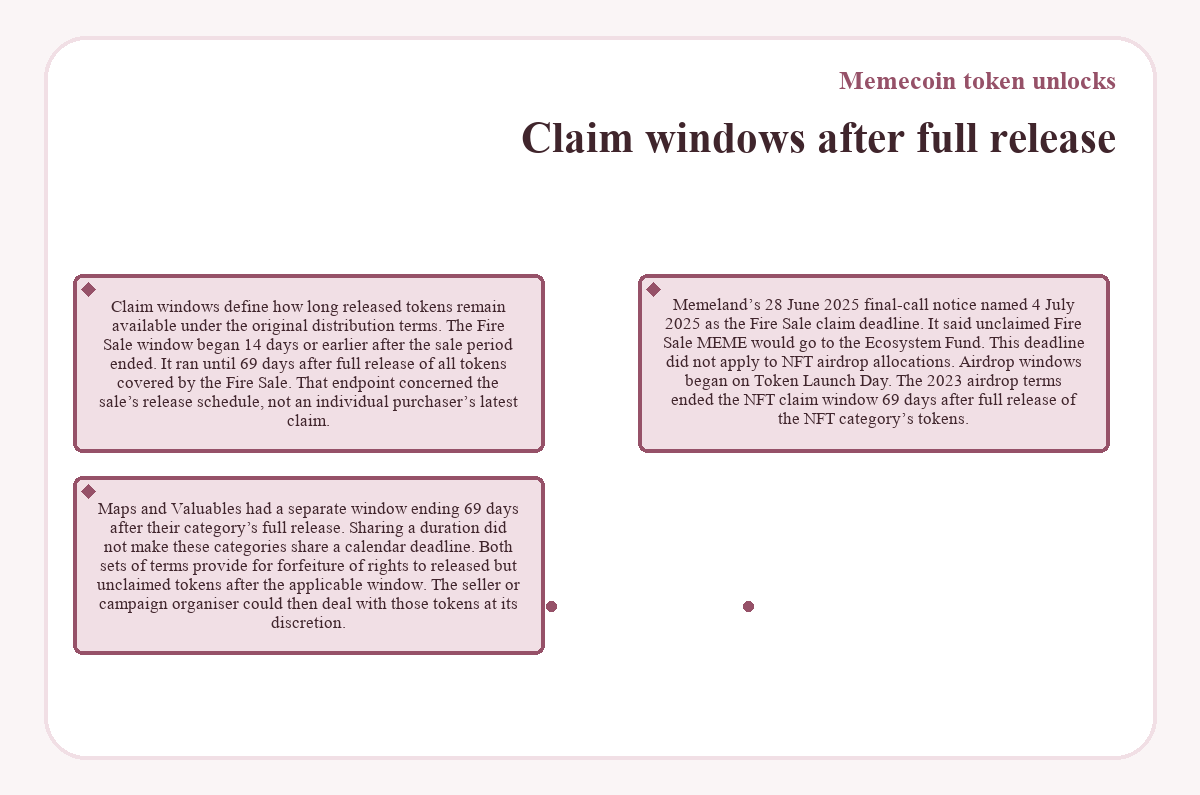
Both sets of terms provide for forfeiture of rights to released but unclaimed tokens after the applicable window. The seller or campaign organiser could then deal with those tokens at its discretion.
Other allocations in the broader unlock calendar
Memecoin’s published claim architecture also distinguishes Presale, Airdrop, Ecosystem and Contributors distributions. Presale includes Community Presale and Private Sale. These claim categories sit within a wider allocation divided into seven main categories with separate unlocking schedules. The original Fire Sale formula does not establish every category’s timetable. Its percentages cannot supply the next Ecosystem or Contributors release date, and an NFT airdrop deadline does not establish a Private Sale deadline.
Gas costs and claim permissions
A claim’s network cost is separate from the MEME amount the schedule releases. Both original distributions place network fees on the claimant each time they request a token transfer. For Ethereum transactions the holder pays directly, those fees use ETH. Computational work and gas prices determine the fee, so no single fixed ETH amount describes every claim.
The MEMECOIN MultiClaim (w/stake) facility combines Fire Sale or airdrop claiming with staking, subject to the relevant claim window. That option also introduces the applicable staking campaign’s conditions. Receiving MEME into a wallet and placing it into a staking campaign leave tokens in different states. ERC-20 spending permissions are another mechanism: they authorize spending and do not establish an original allocation.
Emergency stops and distribution timing
Emergency-stop provisions can interrupt distribution even when a timetable describes an expected release. The Fire Sale terms reserve that power for serious security problems, network-performance issues, material attacks or comparable threats. The airdrop terms separately reserve a power to terminate distribution through an emergency stop. These provisions have different wording and scope. A nominal schedule therefore does not promise uninterrupted distribution or a fixed completion time.
Wallet access before committing a claim
Claiming an NFT airdrop entitlement requires connecting the holding wallet or a qualifying linked delegate wallet recognized by the 2023 rules. The choice concerns access to the same entitlement, not a second allocation. Establishing the holding or delegation prerequisite before submission keeps a wallet-selection mistake from becoming an unnecessary transaction.
An eligible holding or linked wallet
A wallet holding the qualifying NFT supplies the direct route. Clause 5.2 also recognizes a delegate wallet linked to that holding wallet. Direct access avoids the delegation prerequisite; the linked route leaves the NFT in its holding wallet. Either route still needs released, unclaimed tokens within the window. The delegation clause alone does not establish support in every interface.
A wallet without the required relationship
A connected wallet without the relevant NFT or qualifying delegate link lacks that prerequisite. Returning to the eligible holding wallet can resolve a wrong connection before submission. Switching wallets cannot restore a portion a previous holder claimed or revive rights forfeited after the deadline.
- Establish the qualifying NFT holding, rather than relying on an existing MEME balance.
- For delegation, establish the link to the eligible holding wallet.
- Distinguish released, unclaimed MEME from the full allocation.
- Confirm the applicable NFT claim window remains open before submitting a transaction.
Unlock percentages and circulating supply
MEME’s fixed total supply is 69 billion tokens, while unlock percentages can refer to much smaller allocation pools. The denominator matters: a percentage of Fire Sale Purchase Tokens describes a different quantity from the same percentage of the entire airdrop. A tranche is a portion released under a schedule; linear release describes gradual release over time.
Circulating supply also depends on claim activity. A released allocation can remain unclaimed, so adding scheduled unlock amounts does not establish a current wallet balance or an actual sale. For a holder deciding whether to collect tokens, the relevant quantity is the released amount still unclaimed within the governing window.
Key questions about Memecoin token unlocks
How does Hong Kong time affect the original MEME claim windows?
The original Fire Sale and airdrop terms interpret their dates and times in Hong Kong time. A deadline expressed under those terms uses that time basis. The 69-day endpoint still follows the relevant full-release event; converting a timestamp into another time zone does not change which distribution’s event starts the interval.
Can unreleased Fire Sale MEME be pledged before its lock-up ends?
The 2023 Fire Sale terms prohibit pledging Purchase Tokens without Glorious Meme Inc’s prior written consent while the relevant tranche remains locked. Their restrictions also cover arrangements transferring the economic consequences of ownership, including swaps. Cash settlement does not remove those restrictions. These conditions concern the unreleased Purchase Tokens covered by the sale terms.
Does increasing a MEME spending allowance accelerate an unlock?
Increasing an ERC-20 spending allowance changes a spender’s permission, not an allocation’s release timing. An allowance cannot replace a Fire Sale allocation, a required NFT holding or an open claim window.
Are Stakeland withdrawals part of the original MEME vesting schedule?
Stakeland unstaking follows its own campaign terms, separately from original MEME allocation releases. Its Terms of Use, last updated 20 February 2024, describe returning unstaked tokens to the same staking wallet. Arrival time depends on the applicable network, and rewards stop once it processes and verifies the unstaking transaction. Those conditions do not create a new Fire Sale or airdrop claim deadline.
What happens to a MEME claim if the eligible wallet’s private keys are lost?
Losing the required wallet credentials can prevent a claim even after tokens unlock. The 2023 airdrop terms make the holder responsible for wallet security and place the organiser under no obligation to recover or return tokens. A qualifying linked delegate is a separate access route; it does not recover the keys or renew a claim window.
Updated on