 Memecoin
 Spending Approvals, Allowances and Revocation
Memecoin uses ERC-20 allowances to let a chosen spender transfer MEME from the holder’s wallet. The holder can send tokens directly or grant another address permission to spend a specified amount. An approval changes that permission without moving the tokens. The spender can then act within the remaining allowance, subject to the available MEME balance and applicable contract rules. Each permission belongs to a particular owner, spender and token contract on a particular network. Connecting a wallet alone does not create this permission. Unused allowance can let an application move MEME again after the intended transfer.
Direct transfers and delegated spending
A direct MEME transfer uses the holder’s authority, while delegated spending relies on permission granted to the actual spender. The standard function
transfer
moves tokens from its caller’s balance. With
transferFrom
, an authorized caller names the account whose tokens it moves. The function
approve
supplies spending permission for a named address. These operations answer different requests, even when an application presents them within one flow. An approval prompt concerns the spender and its limit; a transfer prompt concerns movement of tokens. The interface determines how it presents the required calls.
| Operation | Caller | What changes | Authority boundary |
|---|---|---|---|
| Direct transfer | The token-holding address | Sender and recipient balances | Uses the caller’s MEME balance |
| Approval | The address granting permission | A spender’s allowance | Names a spender and a MEME limit |
| Delegated transfer | The authorized spender | Token balances and any finite allowance | Needs sufficient permission and available MEME |
Receiving MEME does not require approving the sender to withdraw tokens from the receiving wallet.
What can an approved spender move?
A MEME allowance covers spending from the approving address within the specified MEME token contract. The allowance does not give the spender the wallet’s private key or authority over every asset. Another token contract maintains its own permissions. Another owner address also has its own allowance, even when the same person controls both wallets. Network context matters because the permission belongs to the contract state on that network. An approval recorded elsewhere does not change the allowance of the Ethereum MEME contract.
The live value returned by
allowance(owner, spender)
describes remaining spending permission. MEME reduces a finite allowance by the amount successfully transferred through transferFrom. It treats the maximum uint256 allowance as unlimited, so transferFrom does not reduce it. The owner’s
balanceOf
value describes available tokens. A delegated transfer needs enough of both for the amount it attempts to move.
The approval call targets the token contract, while its spender argument identifies who receives permission. Confusing those addresses can authorize the wrong account.
Changing limits and revoking permission
Calling the ERC-20 approve function again overwrites that spender’s current allowance with the supplied value. The amount is a token quantity, not a percentage of the wallet’s holdings. A larger limit may leave permission for additional withdrawals after the intended operation finishes. Setting the allowance to zero removes future spending authority through that allowance after the update succeeds.
Replacing a nonzero allowance with another nonzero value introduces a transaction-ordering risk. The spender may use the old permission before the replacement takes effect, then use permission under the new limit. The ERC-20 recommendation is to set the allowance to zero before assigning a replacement value. A pending reset leaves any remaining old permission available. Spending before the reset also changes the holder’s balance. The replacement amount should account for any spending completed before the reset.
Revoking one spender does not cancel allowances granted to other addresses. Revocation also cannot reverse a transfer already completed under earlier permission.
Why can spending fail after an approval?
A delegated MEME transfer can fail when its actual spender lacks sufficient allowance or the holder lacks sufficient tokens. An approval for another address does not satisfy the caller’s permission requirement. A displayed allowance can also describe a different wallet, token contract or network from the attempted transfer. Application rules impose separate conditions beyond token permission, including any applicable participation or release restrictions. A larger allowance cannot satisfy those conditions. Check the error against the current allowance, token balance and application rules before changing permission or retrying.
Approval records and ETH fees
A successful approval establishes spending permission; a completed transfer concerns token movement. A transaction hash alone does not prove either operation succeeded. Every successful ERC-20
approve
call emits an
Approval
event naming the owner, spender and value. A token transfer emits a
Transfer
event. Historical approval events describe permission at the time of that call. Subsequent spending or another approval can change the live allowance. The current contract value therefore answers how much permission remains more directly than an old transaction record.
Ethereum transaction gas fees are paid in ETH. An on-chain MEME approval or revocation consumes computation, so the MEME spending limit and the ETH transaction fee measure different things. Gas used multiplied by the effective gas price determines the execution fee. Approving a larger token amount does not make that amount the fee base. A transaction included on-chain can revert and consume gas without applying its intended allowance update. A transaction rejected before block inclusion incurs no execution-gas charge.
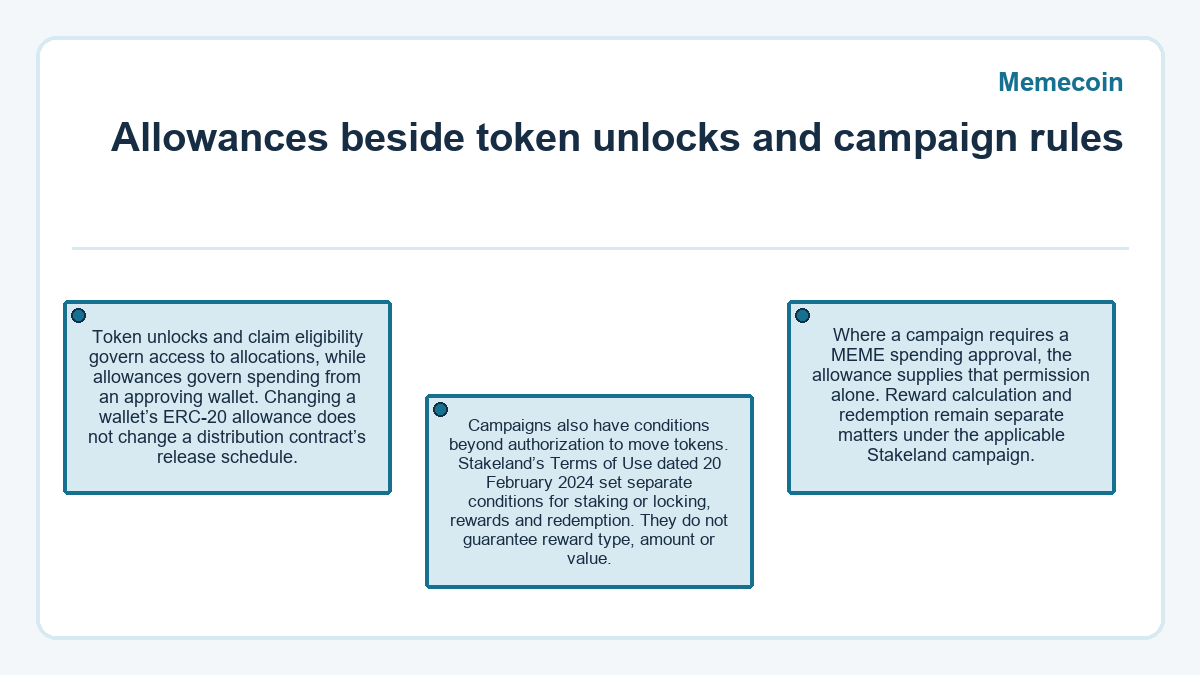
Allowances beside token unlocks and campaign rules
Token unlocks and claim eligibility govern access to allocations, while allowances govern spending from an approving wallet. Changing a wallet’s ERC-20 allowance does not change a distribution contract’s release schedule. Campaigns also have conditions beyond authorization to move tokens. Stakeland’s Terms of Use dated 20 February 2024 set separate conditions for staking or locking, rewards and redemption. They do not guarantee reward type, amount or value. Where a campaign requires a MEME spending approval, the allowance supplies that permission alone. Reward calculation and redemption remain separate matters under the applicable Stakeland campaign.
Common questions, answered
Does disconnecting a wallet revoke its MEME approvals?
Disconnecting a wallet does not change its stored MEME allowances. A connection concerns the application’s access to the wallet interface; an ERC-20 approval exists in the token contract’s state. Closing a browser session or removing a connection does not submit an allowance update. Any remaining approval continues to govern that spender’s token permission.
Can an unused MEME allowance expire on its own?
The standard ERC-20 approve method does not assign an expiry date. Waiting or leaving an application does not, by itself, change a stored allowance. A separate application may enforce a deadline for its own actions. That deadline does not automatically clear permission in the token contract, and a session timeout does not serve as an allowance expiry.
Will an existing MEME approval apply to tokens I receive later?
An outstanding allowance can authorize spending of MEME later credited to the same owner address. The spender remains limited by the live allowance and available balance. Moving tokens out of a wallet does not itself revoke its approvals. A later incoming transfer can therefore increase the amount accessible under permission that still remains.
How do raw MEME approval values relate to wallet display amounts?
The token’s decimal setting determines the conversion between raw approval units and displayed MEME amounts. Contract calls use integer token units, while wallet interfaces can format those units for reading. An allowance and a balance must use the same unit before comparison. A difference in formatting alone does not establish a larger spending permission.
What does a false return value mean for a MEME approval integration?
MEME’s approve function returns true on success and reverts on failure. For ERC-20 integrations generally, false means the approval must be treated as unsuccessful. ERC-20 requires callers to handle false from functions returning a success Boolean. Software cannot assume every call succeeds merely because it avoids a revert. This concerns integration handling; a transaction identifier alone does not establish the resulting allowance.
Can an approved spender send MEME to a different recipient?
ERC-20 transferFrom accepts a recipient address distinct from the approved spender. An application can restrict destinations through its own code, so the actual range of recipients depends on that implementation. The approval itself names a spender and amount without fixing a single receiving address.
Does a MEME approval reserve tokens for the spender?
A MEME approval records spending permission without setting tokens aside. The holder can still send tokens directly, changing the balance available to delegated transfers. Sufficient allowance alone does not establish that the owner has sufficient MEME. The token balance at execution determines whether the attempted transfer has enough available tokens.
Updated on